The Grammar of Identity: From Your Broken Heart to a Forest Fire's Recovery
We're taught that falling apart is something we should work to avoid. We create shields against the world. We build them in our homes, our relationships, our curated online lives. When they're breached, it feels like failure.
The phone goes silent, and the future you built with someone evaporates into thin air. The career you poured yourself into declares you obsolete. A diagnosis arrives, and the invincible person you once knew is now a stranger in a vulnerable body.
We have a thousand words for this state: heartbreak, breakdown, burnout, crisis, trauma. Each one comes wrapped in a story of pathology: something has gone wrong. You're broken. You need to be fixed.
But what if we look to nature and think about a forest after a wildfire?
There's no story of pathology here. There's no lament.
The towering pines are blackened spires. The underbrush is ash. The silence absolute.
This isn’t a tragedy in the forest’s language; it’s a fact of nature.
A devastating, total, and necessary fact.
And in that silence, something is already happening. Beneath the ash, seeds that have waited decades for a glimpse of sun are stirring. Nutrients locked in old wood are being released into the soil. The community's structure is gone. Who gets light and who gets space has changed, making room for a new landscape.
Do you think the forest is broken? Or do you see that the forest is in process?
The Universality of Falling Apart
This is the haunting and beautiful disconnect. We experience collapse as a falling-away from life. Yet everywhere else in nature, collapse is the very engine of life's renewal.
So, what have we forgotten that’s known by nature?
What if your lowest moment, the one that feels like an end, is a perfect expression of life's deepest rules? What if there's a universal grammar of holding together? One that your heartbreak, the forest fire, and the collapse of a nation all speak in different accents?
Naming the Cycle
The gap between our suffering and nature's renewal is a matter of story. It's not a matter of wood and flesh, or emotion and chemistry.
We tell ourselves a story of permanence. We choose a school, build a career, find a partner, make a home, creating islands of stability in a chaotic world. But the living world tells a story of stability and rupture.
Every identity, whether a mind, a body, an ecosystem, or even a culture, navigates the pressure to change. We'll call this a pattern of holding together.
It boils down to an observable four-phase cycle. You can see this wherever a system maintains a “self” across time. You can see it in the data of a recovering immune system. It can be traced in the minutes of a historic debate. And you feel it in the wake of your grief.
The Four-Phase Cycle of Transformation
Impact
Difference is introduced, disrupting stability. The world insists:
You must change.
For us, it’s a betrayal.
For a forest, it’s a flame.
For a nation, it’s a revolutionary idea.
There are times when the impact of the event is painful and immediate, impossible to ignore. But sometimes, the impact comes long after.
Digestion
The system metabolizes what entered, attempting to break it down into something integrable. It’s feeling the feeling and thinking the thought. It's finding meaning and connecting with others.
In a body, a cell digests food, breaking complex chains into usable sugars and amino acids.
In a society, we debate, protest, create art, and share stories. It's the public struggle to absorb a new reality.
Transformation
Digestion reaches a threshold. The old structure collapses into potential. From this dissolution, a new configuration emerges. It’s a reorganization.
The pain shifts from a present wound to a part of your history.
A debated idea becomes the norm. Institutions change, and a new national identity forms.
The system becomes something else while somehow remaining itself.
Expression
The changed system moves in the world. It behaves differently. It creates different boundaries, seeks different resources, tells a different story.
We pursue forgotten passions and choose healthier foods.
Laws change across civilizations. New art defines each era. Daily routines shift with new technology.
Actions from a new state become new facts in the environment, impacting other systems.
This cycle appears wherever a system maintains a "self" across time. This four-phase pattern describes how living systems process disruption and emerge changed. From cellular metabolism to cultural evolution.
Healthy systems aren’t unbreakable. They too break open and re-form. The key is that, rather than resisting it, they adapt.
Your pain’s a sign that you’re still in process. You’re following an ancient protocol for staying alive in a changing world. And speaking the natural tongue of resilience, even if you can’t yet hear the words.
Three Proofs of the Grammar
Seeing the grammar in one place might be a coincidence. Seeing it in three different scales of: a person, an ecosystem, and a civilization, is a pattern. Let's trace the same four-phase shape through each.
The Broken Heart
-
Impact
The text message. The confession. The silence where promise used to be. A future you'd built your identity around vanishes.
This is an unmanageable input, a story you can't reason yourself out of.
-
Digestion
This is the inner processing, often mistaken for instability.
You're trying to make sense of the pieces.- You replay memories.
- You rewrite the story of your life, of them, of love itself.
- You call friends, simply wanting to be heard.
- You write bad poetry, blast the same song, or walk for hours, trying to make the pain mean something.
-
Transformation
There’s no single moment you can pinpoint. But eventually, you realize the pain’s shifted. The "you" who loved that person is gone. In their place is someone new, existing in a different world.
You might still feel the pain, but you’re learning to live in your new world, no longer losing the old one.
-
Expression
You take a trip. You catch up with an old friend. You write a song. You move through the world with new boundaries and a quieter, more resilient hope.
You haven't "gotten over it." You've reorganized.
Want to Explore Grief More Deeply?
This transformation is rarely linear. For a closer look at the day-by-day rhythm of navigating such a loss, and deeper exploration of lived experiences of grief:
Read: How Can I Live When They Don't?The Forest Fire
-
Impact
The crown fire. The very rules of the old community are cremated.
The canopy that shaded out saplings is gone. The thick floor of needles preventing seeds from rooting is ash. The input is total, lethal, and absolutely necessary.
-
Digestion
The forest persists. The ecosystem slowly breaks down raw materials into usable components.
- Fire-activated seeds crack open.
- Mycorrhizal fungi redistribute nutrients from dead roots to living ones.
- Beetles and birds clean the bones of the dead.
-
Transformation
The first pioneer species, like fireweed and lupine, rise from the ash.
They're a new configuration, a new forest, one suited to bare soil and full sun. They hold the soil, fix nitrogen, and create shade for the next generation of tree seedlings.It's a shift from an old and vulnerable forest to a diverse and fire-adapted community. Animals can finally return.
-
Expression
The new forest retains water differently, slowing runoff. It supports different birds and insects. It even changes local wind patterns.
Its very existence alters the landscape, creating conditions for its own future design.
Visualizing the Cycle
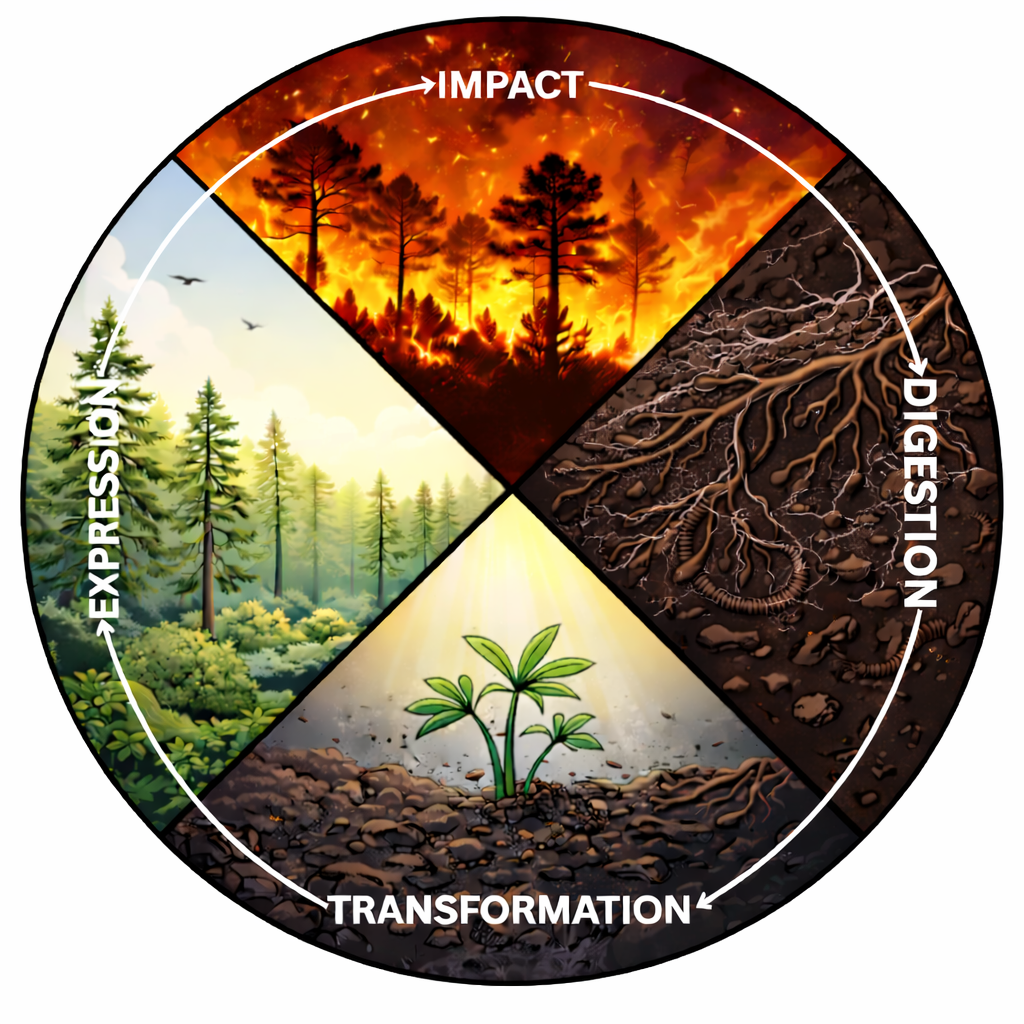
From wildfire to heartbreak, living systems metabolize disruption through a universal four-phase cycle.
The Fall of the Berlin Wall
-
Impact
The peaceful revolutions of 1989 rendered the Wall an unmanageable fact. It was a symbol of divided identity. Its physical opening was an input that the system of "Two Germanys" couldn't process.
-
Digestion
The physical barrier was down, but there were many things to sort through.
East Germans explored a new world while West Germans confronted an unexpected reality. The Stasi files were opened. Society sorted through the rubble of a collapsed ideology. They grappled with hope and loss in a phenomenon known as Ostalgie.
-
Transformation
The old identity dissolved. From that potential, a new configuration eventually emerged: a single, reunified German state.
Like most transformations at this scale, it wasn’t an overnight process. This was a metamorphosis into a new political and social entity, the "Berlin Republic."
-
Expression
The new Germany took a different path. It rebuilt its capital and anchored a larger Europe. It forged a new narrative of peaceful revolution.
The shattered concrete of the Wall became the bedrock of a new and more stable identity.
The View from Inside
Of course, no one in 1989 experienced it as: "Impact → Digestion → Transformation → Expression." They felt chaos, fear, hope, and logistical nightmares. Everyone faced their own struggles. Every family had hardships to overcome. Each person began their integration into the new world on a personal scale.
At a collective scale, the grammar's the pattern we can trace in hindsight. It's the underlying shape of how a collective identity absorbs the unthinkable. And of how it emerges, changed, on the other side.
When we look closely, we see the same shape. Every time.
Impact → Digestion → Transformation → Expression.
A person, a forest, a nation. Each encounters a force that disrupts its current stability. Each processes input in its own way: in tears, biochemistry, or heated debate. Each reaches a tipping point where the old configuration falls away and a new one forms.
Each contributes to a new world.
Living the Pattern
We've seen the same shape in the fragments of your heart, the soil of a burnt forest, and the rubble of a torn-down wall. Now, a fundamental truth comes into focus:
There's no separate "you" that goes through transformation.
You are the process of transformation itself.
The grief, the silence, the confusion, aren't obstacles on the path to becoming yourself. They are the path. We are all, always, living this pattern of holding together. The question is whether you’re living it consciously, as a participant in your own becoming.
We can’t build an identity that can withstand all storms. But we can become more resilient. We can become more skilled in the art of transformation.
We fear collapse, mistaking it for an ending. But really, it's the necessary midpoint of all renewal. Not every impact is avoidable.
Your task is to train your ability to metabolize the fires of your life. Betrayals, losses, leaps into the unknown—the inputs never stop.
This is the shift from a passive to an active existence. From existing as an individual to participating in the dynamic project of being.
A New Story
We stand at a threshold in our understanding of ourselves. For centuries, we've used a language of mechanics to describe the self. The gears, levers, broken parts that need fixing. But we’re not machines. We're living processes, as self-renewing and context-dependent as a watershed or a language.
Trees fall. And in falling, they become something else. They become nurse logs, shelter, and nutrients feeding the next generation of roots. No system in nature holds its form forever.
Empires fall. The Roman Empire became the languages and institutions that shaped future civilizations. The fall of the Ottoman Empire brought the borders and tensions that define the region today. Collapse, at every scale, has always been a reorganization.
Can a single grammar truly apply across these incredibly different scales?
It can. The grammar is about how any system maintains a self across time. And that shape is the same. You can trace it in a fallen tree, the ruins of an empire, or the quiet reformation happening inside you right now. Scale is irrelevant.
The Grammar of Identity offers a language for this universal process. It might not shield you from the fire, but it can help you understand it and recover afterward.
So the next time the ground falls away, you'll know: you aren't broken.
You're between forms. And that’s where all new things begin.
Your Next Step
This grammar is both a lens for understanding and a tool for navigation.
For Your Inner World
If you're done seeing your pain as a problem and want to view it as a journey, this work is for you.
Start mapping your own inner voices and understanding healthy digestion. Learn to navigate your transformations rather than fight them:
Be the first to know when "The Process of Identity: A Guided Introduction to Witness Field Theory" becomes available.
For Our Shared World
Do you view our institutions, politics, and struggles with technology as part of the same cycle?
Join our growing community in exploring the deeper patterns shaping our shared existence.
Receive applied insights on living systems, from organisms to organizations to ecological healing.